
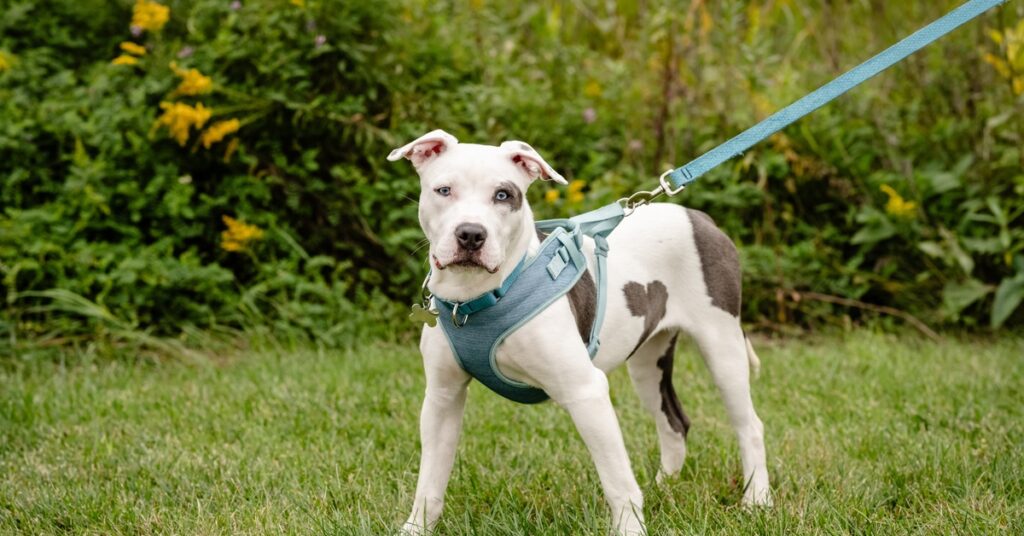
Every corner holds the potential of an outburst when walking a reactive dog. To prevent pulling on the leash and hurting the dog’s neck, many dog owners choose harnesses. But this tool isn’t the best choice for your pup’s health.
Harnesses encourage pulling and limit your control. Learn the reasoning behind why you shouldn’t put a harness on your aggressive dog, and find an alternative solution.
The Mechanics of the Opposition Reflex
Dogs possess a natural instinct that trainers call the opposition reflex. When a dog feels pressure against a part of their body, they instinctively push back against it with equal force.
A harness rests across the strongest part of your dog’s body, specifically the chest and shoulders. The placement invites them to lean in and pull with all their might against the restraint. You activate the pulling instinct immediately when restraining a dog by the torso. It tells the dog to move forward with power rather than yielding to the leash.
Why Forward Motion Escalates Emotion
An aggressive dog already wants to move toward the trigger with intensity and speed. The harness gives them the mechanical advantage to do exactly that, fueling their forward momentum. This physical exertion ramps up their adrenaline and mental arousal levels. You create a scenario where the dog works against you while their excitement builds.

The Physics of Leverage and Control
The Center of Gravity Problem
Controlling a large or powerful dog requires mechanical leverage, not brute human strength. A harness places the point of control near the dog’s center of gravity, right behind the shoulders. Dogs are able to use their full-body weight and muscle mass against your grip. You’re sure to lose a tug-of-war match against a determined animal in this position every time.
Comparing Head Control and Body Control
Control of the head equals control of the body in almost every animal species. If you control the neck and head, you influence where the dog looks and how they move. A harness leaves the head completely free to scan the environment for potential threats. Your dog fixes their gaze on another dog or person without any physical interruption.
The Disadvantage of Human Strength
Even a smaller dog feels surprisingly strong when they engage their core muscles against a body harness. You end up being towed behind them like a water skier holding onto a boat. This lack of leverage puts you in a dangerous position if your dog decides to lunge. You risk injury to your shoulders or back while struggling to hold them back.
Communication Breakdowns on the Leash
The Language of Leash Pressure
The leash acts as a telephone line between you and your canine companion. It should convey subtle signals, directions, and guidance from your hand to their body. A harness muddies this communication because it distributes pressure over a large, insensitive area. Your dog won’t feel the subtle cues you send, so they ignore the leash entirely.
The Feedback Loop of Anxiety
A tight leash communicates tension directly to the dog through the harness. Since a harness encourages pulling, the leash remains tight almost constantly during the walk.
Dogs sense static tension and assume you’re nervous about the environment, too. They interpret tightness as a signal that a threat exists nearby, thereby validating their aggressive emotions.
Losing the Ability To Interrupt
You need the ability to snap your dog out of a hyper-focused state before they react. A harness dampens any attempt to interrupt their fixation on a trigger. When you pull back, you only engage their body, leaving their mind locked on the target. Without a way to physically interrupt the brain, the aggression continues to escalate.
Safety Risks You Cannot Ignore
The Mechanics of Escaping
Aggressive outbursts involve violent twisting, turning, and backing up as the dog panics or rages. Many dogs learn that they escape a standard harness by backing out of it swiftly. A panicked or enraged dog changes shape as they struggle against the equipment. They drop their head and pull backward, slipping the harness right over their shoulders and head.
The Danger of Redirected Bites
Handling a harness during a fight puts your hands in a vulnerable position near the dog’s mouth. If you need to grab the harness to pull your dog away, you risk a redirected bite. In the heat of the moment, the dog may strike out at anything touching them. A leash attached to the neck keeps your hands further away from the danger zone.
Unintentional Reinforcement
Every time your dog pulls toward a trigger and you follow, they feel rewarded. The harness lets them drag you closer to what they want to attack or investigate. It’s a win that reinforces aggressive behavior.

The Truth About Collars
People avoid collars because they worry about tracheal damage or hurting their pet. The fear comes from seeing dogs choke themselves on flat collars while pulling relentlessly. However, the tool itself causes less harm than the behavior of uncontrolled pulling over time. A dog that walks calmly on a loose leash faces no risk of neck injury.
The Reality of Tracheal Safety
Tracheal damage usually occurs when a dog pulls consistently against a flat collar for years. The solution is not to move the connection point to the back, but to stop the pulling. Moving to a harness ignores the behavioral issue and simply creates a stronger puller. We aim to stop the pulling behavior entirely rather than accommodating it with different gear.
The Goal of a Loose Leash
The objective of every walk should be a loose leash with no tension. Your dog should walk beside you, checking in with you for guidance and direction. This state of mind is impossible to achieve if the dog leans into a harness. Removing the harness is the first step toward achieving a calm, structured walk.
Address the Root Cause Through Dog Training
It’s valuable to know why you shouldn’t put a harness on your aggressive dog, but you must also address the underlying state of your pet’s mind. Aggressive dog training focuses on changing how the dog perceives the world and their place in it.
The trainers at Innovative K9 Academy know not to leverage harnesses and understand how to correct aggressive dog behaviors. Sign up for our dog training boot camp to stop your dog from pulling on a leash with the assistance of our experienced team.